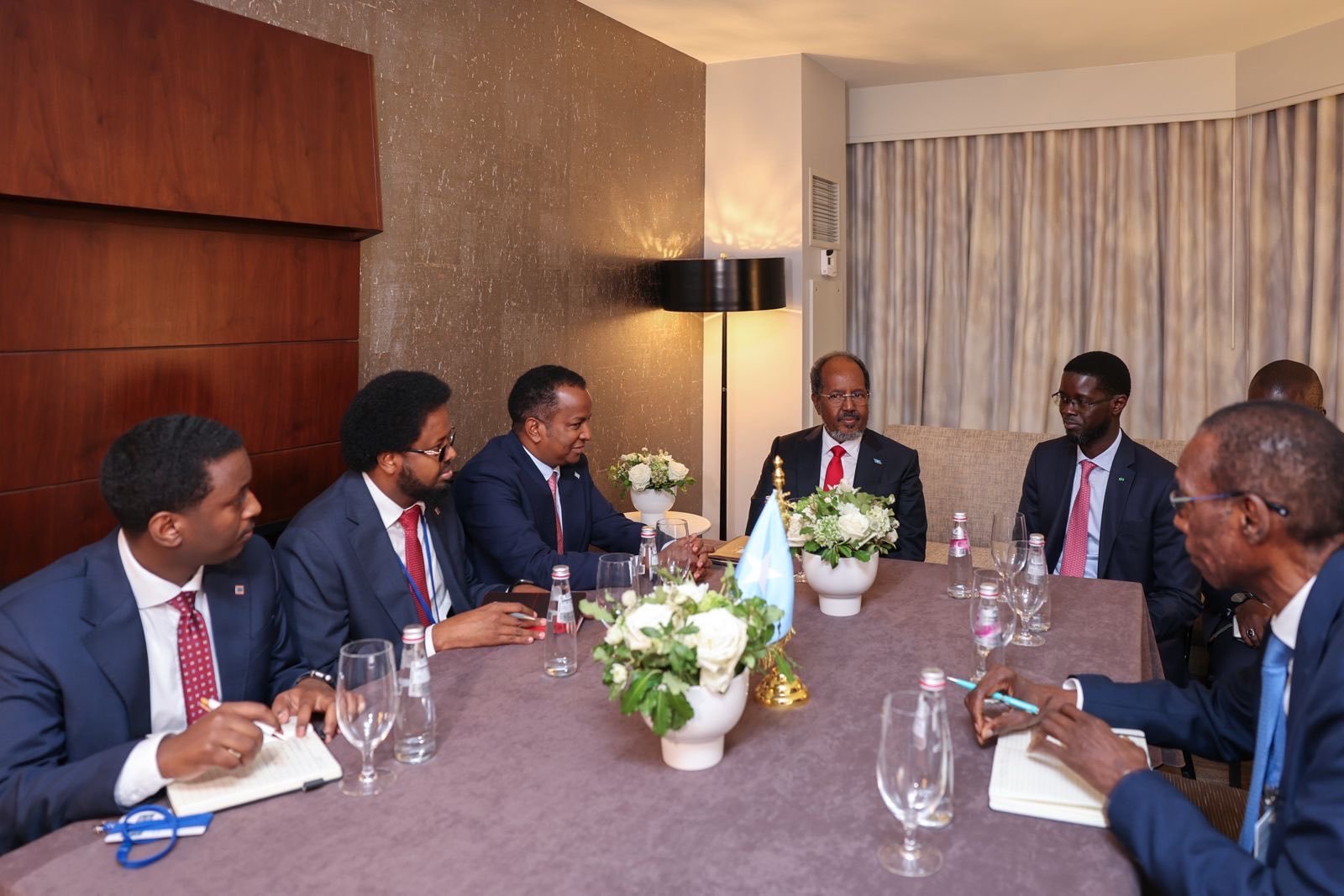
Somalia has come out of the 81st session of the United Nations General Assembly with ten bilateral engagements and one new diplomatic relationship, spread across four continents and conducted at two levels of government.
President Hassan Sheikh Mohamud took part in the opening of the session and addressed the Assembly on the country’s progress on economic reform, on eliminating the threat of international terrorism, and on the move to direct elections. Around that he held bilateral meetings with the President of Serbia, Aleksandar Vučić, the President of Senegal, Bassirou Diomaye Faye, the Prime Minister of Pakistan, Muhammad Shehbaz Sharif, and the Crown Prince of Kuwait, Sheikh Sabah Khaled Al-Hamad Al-Sabah, together with the United States Assistant Secretary of State for African Affairs, Frank Garcia.
The Minister of Foreign Affairs and International Cooperation, Abdisalam Abdi Ali, met the foreign ministers of Egypt, Algeria, Morocco, Costa Rica and the Dominican Republic. The Deputy Prime Minister, Salah Ahmed Jama, took part in a discussion on rural food security held alongside the session.
A new relationship in the Caribbean
The most concrete result was an agreement rather than a conversation. The Foreign Minister and his Dominican counterpart, Víctor O. Bisonó Haza, signed an agreement establishing diplomatic relations between the two countries, and agreed to strengthen coordination at the United Nations. The Ministry described the step as advancing Somalia’s effort to widen its partnerships across Latin America and the Caribbean.
That description was borne out within the same week. The Foreign Minister also met Costa Rica’s Minister of Foreign Affairs and Worship, Manuel Tovar Rivera, for talks on bilateral relations and shared interests in development cooperation. Two engagements in one session is a modest figure in itself, but Somali diplomacy has had very little presence in Latin America, and the Ministry has now named the region as a direction of travel and taken two steps in it.
Security files at four tables
The security questions facing Somalia appeared in different forms depending on who was across the table. With Kuwait the President discussed cooperation in security, diplomacy and development, and the two also took up regional security in the Middle East. With Egypt the Foreign Minister discussed strategic cooperation with particular attention to security in the Red Sea and the Horn of Africa, and Egypt again stated its support for the sovereignty, unity and territorial integrity of the Federal Republic of Somalia.
That Egyptian commitment has now been made three times in two months, following a telephone call between the same two ministers in August in which Egypt pressed for sustained financing of the African Union mission in Somalia, to which it contributes troops. Similar assurances on Somali sovereignty were given by China in August. Somalia has been accumulating these statements, and the pattern is as notable as any individual instance of it.
The meeting with the United States Assistant Secretary of State was the shortest readout of the week, covering bilateral relations and shared priorities of mutual interest, and it carried weight disproportionate to its length. It took place while the financing of the African Union mission remains unresolved and after the United Kingdom publicly linked its future support through the United Nations Support Office to progress on political dialogue and on the security transition.
Serbia, Senegal and Pakistan
The meeting with President Vučić continued talks begun three weeks earlier, when the two presidents met in Belgrade between 31 August and 2 September. In New York they discussed the next steps in strengthening relations, broadening cooperation and the situation in the Horn of Africa and beyond. The President thanked Serbia for its consistent understanding and cooperation and welcomed opportunities in economic and security cooperation and joint projects.
The Pakistan meeting follows the arrival in Mogadishu in August of Aqsa Nawaz, the first woman Pakistan has sent to Somalia as ambassador, who presented her credentials at Villa Somalia. The Senegal meeting was the only engagement of the week with a West African state.
Food security taken to the donors
The Deputy Prime Minister used the margins of the session to put a funding case. Speaking at a Global Citizen NOW discussion on rural food security alongside the President of the International Fund for Agricultural Development, he said much of Somalia depends on agriculture and livestock and that climate shocks threaten rural livelihoods, and called for greater investment in climate-resilient agriculture, water, livestock and rural value chains, and for a strong fourteenth replenishment of IFAD.
It is the same argument he made in Mogadishu last month at a World Food Programme warehouse, where he told the United Kingdom’s Minister for Development and Africa that the districts closest to famine are among the most peaceful in the country and that the crisis there results from weather shocks accumulated across successive seasons. In New York the argument came with a specific ask attached.
What the week amounted to
Türkiye’s President, Recep Tayyip Erdoğan, reaffirmed his country’s support for Somalia during the session, saying Ankara remains committed to strengthening Somali security, development and state institutions.
Ten engagements across the Gulf, North Africa, West Africa, South Asia, Europe, the Caribbean, Central America and Washington is a wide week for any foreign ministry, and a notably wide one for Somalia. It also continues a quarter in which Somalia has been rebuilding its diplomatic reach: an ambassador fully accredited in Tokyo for the first time since 1990, credentials presented in Khartoum, seven ambassadors received at Villa Somalia in a single morning, Algeria reopening its embassy in Mogadishu, and two cooperation agreements approved with Mauritania. The General Assembly gave that work a week in which most of it could be done in one building.